|
From Anthony
Bourdain's 'Kitchen Confidential' Adventures in the Culinary Underbelly (Bloomsbury - 2001)
"These were
not the cream of the crop, my fellow culinarians. It was 1975 and CIA (Culinary Institute of America) was still getting
more than their share of farm boys, bed-wetters, hicks, flunk-outs from community colleges and a few misfits for whom CIA
was preferable to jail or juvenile detention. Hopeless in the kitchen, happy in their off-hours to do little more than build
pyramids of beer cans, they were easy marks for a hard case like myself."
From Robert B. Parker's 'The Godwulf Manuscript'
(Mystery Guild, 1973)-
"In my kitchen I sat at the counter and opened a can of beer. It was very quiet. I turned
on the radio. Maybe I should buy a dog, I thought. He'd be glad to see me when I came home. The beer was good. I finished
the can. And opened another."
From Yann
Martel's classic castaway tale, 'Life of Pi' (Harcourt, 2001) ... "One day we came upon trash. First the water glistened
with patches of oil. Coming up soon after was the domestic and industrial waste: mainly plastic refuse in a variety
of forms and colours, but also pieces of lumber, beer cans, wine bottles, tatters of cloth, bits of rope, and, surrounding
it all, yellow foam."
There were
tanks slowly turning red, quonset huts overrun by jungle, stacks of rotting food in which a few pot-bellied natives and slim
dashing parakeets picked, beer cans melting into the mud. The long white strips of airfields grew a fuzz of green that thickened
and then finally swallowed the asphalt and cement completely. The temporary docks rotted and sank into the ocean. The only
orderly thing left in the rich tropical chaos was the trim rows of white crosses, row on row, marvelously neat and well laid
out.
From Eugene Burdick's 1956 classic novel "The Ninth Wave" published by Houghton Mifflin Company, Boston.
"Before the invention of tin cans, beer was a perishable commodity. As a result, during the seige, stranded travelers
consumed beer first, followed later by a supply of hard liquor. Cooley's Hotel in Springfield was a lively location at which
to weather a winter storm." (reference is to a blizzard in 1888 in New England.)
From Massachusetts Disasters: True Stories
of Tragedy and Survival. Globe Pequote Press (Insider's Guide), Guilford, CT, 2006.
Excerpt below is from 'Plastic:
A Toxic Love Story' (Susan Freinkel, HMH Publishing 2011)
"By the time
he (Nathaniel Wyeth) perfected the PET bottle, the beverage industry was already well on its way to abandoning that two-way
system. It was a change that had its roots in World War II, when Anheuser-Busch and Coca-Cola shipped beer and soda to soldiers
overseas in billions of cans and bottles that the companies knew were never coming back. But the soldiers did return - enamored
with the convenience of non-returnables- and created a demand that helped keep the beer can alive."
from John Grisham's 'The
Summons'....(Bantam Dell, copyright 2002)
"Harry Rex lumbered into
the kitchen, and returned with a tall can of Pabst Blue Ribbon. "I don't know why he buys this stuff," he mumbled, then
gulped a fourth of it.
----------------------------------------------------------
"He counted three young men
and three young women. Their beer cans glinted in the firelight. Thanks to a thundering boom box (with which one of them was
now doing a tango), they hadn't heard Sammy Tigertail's somewhat unstealthy approach."
-from Carl Hiassen's very
entertaining book 'Nature Girl' - published in 2006 by Knopf Publishing.
"He kept rubbing his cheek and looking back and forth between the old New Yorker ad he was holding-
"It's time to elect Miss Rheingold 1950! Your vote may decide ! " - and the two small corpses at his feet. "My old man drank
Rheingold," he said. "Had a can every night with his supper." "One can?" I said. "Well, there's the difference between
your old man and mine."
- from Wally Lamb's 'The Hour I First Believed'. (Harper Collins e-books)
(from William Lashner's thriller "Past Due" - Harper Collins, 2004)
"(the funeral) had been an almost touching ceremony at the burned out building that had once been Lonnie's shop, what
with the howl of motorcycles, the roar of boom boxes, the belch of the beer cans in tribute before one of the motorheads had
taken the urn with Lonnie's remains, opened the top, tossed it high into the air so the metal dropped into the burned out
hulk of his shop and his ashes fell upon the mourners and the neighborhood where he had worked and died."
From "Hotel Honolulu" by Paul Theroux (Houghton Mifflin, 2001)...
"His new wife and her uncle and aunt sat stunned and damp after the wedding reception. They had been exuberant at the reception,
but their bewilderment in Buddy's room made them anxious, and attentive in a fearful way. He was not dismayed that no one
laughed. He took papers out of his briefcase, opened a can of San Miguel beer, took a sip, and began..."
From "The Fledgling" by Jane Langton (Harper Collins, 1980)
Turning away, he (the old goose) paddled by himself to a sheltered cove on the other side of the pond, heading for a
place he remembered from years gone by, a place where acorns were scattered thickly on the ground.
And then he saw the present.
It was bobbing in the shallows, floating in the water, bumping the alder stems, nudged by empty beer cans, brushed by
downy pinfeathers that had scudded across the pond (Walden Pond).
This excerpt taken from "Pacific War Diary, 1942-1945",
by James J. Fahey, (HMCo. 1963) who was stationed on the U.S.S. Montpelier during the war in the Pacific in WWII...
" Thursday, February 8, 1945: I received recreation on
the beach today. Everyone was given two cans of beer. Each ship carries its own supply of beer. Some of the men played
football. The fellows from my division, using a tennis ball in place of a football, went through the motions. A group
of Filipinos passed by, a few of them were girls about 20 years old. They had three water buffaloes with them...about
half an hour before leaving for the ship, we lay in the shade under the palm trees and let the breeze blow on us. Away
off in the distance I could see the high green hills and mountains. It felt good to lay and look at this beautiful scenery.
There are still many Japs up in those hills hiding out..."
"Ten minutes later Clete walked through the door with a pizza in
a flat box, a can of Jax in one coat pocket, and a Dr. Pepper in the other. His porkpie hat was tilted down
on his forehead. He sat on the side of my bed and flipped open the top of the box, his intelligent green eyes smiling
at me."
(from 'A Morning For Flamingoes, by
James Lee Burke - Avon Books 1990)
"By dawn, the raft had been found, wedged sideways under a piling
of the I-90 bridge, due west of Lozeau. The oars had been lost, and the raft contained no clues to the identity of the missing
angler. An empty can of Colt 45 and a crumpled Snickers wrapper were the only evidence of a human passenger."
(from
'Striptease' by Carl Hiaasen)
"(Al) Kaline had a presence that proclaimed him too good for our neighborhood,
too athletic, too upright, too rich. Not that we wouldn't have loved for him to live among us. It's just that we knew
he never would. But imperfect Mickey Lolich, with his belly, would have fit right in, changing his car oil in the driveway,
gulping a can of Altes Beer on the porch, dangerously reigniting the charcoal-grill fire by squirting starter fluid
into the fading flames."
from
Tom Stanton's 'The Road to Cooperstown', 2003, St. Martin's Press
(well, this one refers to beer, not in cans, but it's still worthy of inclusion since it has a local Boston angle to
it!)
"Whitey (Bulger) would be the head on (FBI agent) Connolly's glass of beer."
from "Black Mass" by Dick Lehr & Gerard O'Neill (Perseus Books, 2000)
This suggestion came in from Jim Cannizzaro (Mansfield, Mass.)
How about "Great Beer Can Moments in Motion Pictures?" Great idea Jim! Let's let Jim, a movie buff of
the highest order, get us started...
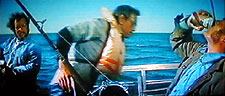
Quint (Robert Shaw) crumples a beer can to show his masculinity. After a beat, the bookish Hooper (Richard
Dreyfuss) crumples a Styrofoam cup.---"Jaws", 1975
Thanks to Joe Zeller for the next two additions ...
"In the movie Old School there is a quick glimse of a beer
can collection in the "kitchen scene".
Also, the movie 'La Bamba' has a black Miller High Life flat-top
in it. The actor opens it with a churchkey.
----------------------------------------------------------------------------------------------------------------
In John Hughes' famous 1985 film, 'The Breakfast Club', Old Style Beer, in cans , is consumed when
the janitor 'Carl' is chatting with Richard Vernon.
This one came from Robert Hedlund..(Thanks for the contribution!)
Rocky 1976, Sly Stallone sips Schmidts
in multiple scenes
M*A*S*H - Early in the film, Elliott Gould opens a flat
top Pabst Blue Ribbon can with a churchkey opener! Nice work with getting the appropriate can for the appropriate year!
In 'The Deer Hunter', cans of Pennsylvania brewed (at the time) Rolling Rock (circa 1970) play prominent
roles throughout.
In a classic scene in 'Animal House', Bluto (Belushi) smashes a beer can against his forehead. The film
is set in 1962, before aluminum cans hit the market, so that would have been a very painful STEEL can in the noggin. Ouch!
Jack Lemmon enjoys some Schmidt from a 16 oz. aluminum can right before ice fishing in 'Grumpy Old Men'.
Hamm's Beer in cans makes a showing in "Falling Down" when a very angry Michael Douglas visits the Korean
shopkeeper's convenience store.
A bitter Clint Eastwood enjoys shipping Pabst Blue Ribbon from cans in "Gran Torino".
Towards the end of the classic Rockumentary "Spinal Tap", the band members are seen drinking cans of Schlitz.
Cans of Ballantine and Budweiser both make appearances in their aluminum forms in 'Saturday Night Fever'.
In the movie 'Gone, Baby, Gone', based on the Dennis Lehane novel, Amy Ryan's character Helene pops open
a can of Schlitz in one scene.
In 'Taxi Driver' (classic Oscar winner from 1976) two cans of Schaefer make an early appearance and a can
of Budweiser makes a later appearance!
In 'Close Encounters of the Third Kind' the visiting alien ship swoops over some country folks enjoying
Budweiser beer from cans!
Jeff Bridges (Bad Blake) enjoys a 'barley pop' (can of Pabst Blue Ribbon) while fishing with Robert Duvall
in 'Crazy Heart'.
In the comedy classic 'Airplane', cans of Miller and Miller 'Lite' can be seen in the galley area of the
challenged airliner. And stop calling me Shirley.
In '8 Mile', a few different beer cans appear in the film, some in the trailer that Eminem's character lives
in, and others (appear to be Schlitz) right before the big rap challenge at the 'Shelter' near the end of the film.
In 'Stripes', after Bill Murray's character (John) quits his job as a taxi driver early in the film,
Harold Ramis's character (Russell) grabs a can of Schlitz from the fridge as they start talking about joining the army.
In 'Anchorman', starring Wil Ferrell,
|
|
| Quint and Narragansett in 'Jaws' |
|